


Up late at in the library reading about differing views on the Baptism of the Holy Spirit. Is it something that happens instantaneously as we are converted to and regenerated in Christ, or is it a second work of God's grace which equips us for ministry?
What do you think?
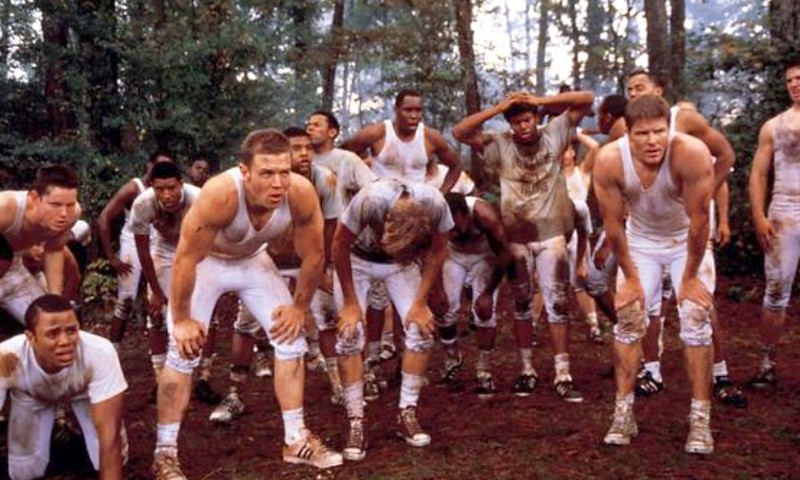
Remember 'Remember the Titans'?
Culture change is tough - but it is worth it!!! I was reminded of this as I watched the movie Remember the Titans. A coach dropped into a chaotic situation must bring culture change for the team to survive... but he doesn't just want it to survive he wants it to succeed, and to dominate. In a way we want our ministries to do likewise so what ideas for culture change can we take from Coach Boon?
Thinking about sacrifice
If Jesus is King, what does that mean for what we want to do with out lives? [Image by Chris Bellerophon Dotson on flickr]

Back to the Mission
Reminded again and again about what we are created for. We are created for worship! But because there are some people who do not worship, we have been given a mission... to go and show people they were created to worship! - photo on Flickr by llamatofu

Appeasement verses Satisfaction
Do we look to appease our emotions, troubles, discomforts with earthy things that may provide some release temporarily, or do we look to God who is the source of complete satisfaction? [Image by donald_palansky_photography on flickr]

Thursday, 31 March 2011
Thursday, 24 March 2011
Very Cool
Long ago, at many times and ain many ways, God spoke to our fathers by the prophets, but in these last days he has spoken to us by his Son, whom he appointed the heir of all things, through whom also he created the world. He is the radiance of the glory of God and the exact imprint of his nature, and he upholds the universe by the word of his power. After making purification for sins, he sat down at the right hand of the Majesty on high, having become as much superior to angels as the name he has inherited is more excellent than theirs.
Jesus is God! Not a god, not a creation of God, not even simply God's son - but he IS GOD :-)
Wednesday, 23 March 2011
Calvin on why we are certain the Bible is true.
Calvin insisted that the testimony of the Holy Spirit is superior to reason. It is an inward work that captures the minds of those who hear or read Scripture, producing conviction or certainty that it is the Word of God with which they are dealing. This is a second work of the Holy Spirit with respect to the Scriptures. He who had originally inspired the prophets and apostles to write the Scriptures now penetrates our hearts, convincing us that these Scriptures are indeed the Word of God and thus truth.Erickson, M J 1998, Christian Theology (2nd Ed), page 869
Long time ago...

Was looking through old blog posts the other day and came across this old photo. That's my first car (a 1986 Ford Laser). It had broken down, the alternator had died... we'd tried to push start it but it just wouldn't go.
So I left it there and called RACQ for help... and it still took 45 minutes for a guy to arrive :-p
Tuesday, 22 March 2011
3 Elements of a Healthy Pastoral Team
1. Understanding and striving for a common Godly vision.
The ultimate Lordship of the team lies with God. A vision – possibly as broad as ‘The Great Commission’ (Matt 29:19-20) or something specific regarding the local ministry – should be the defining point for which the team works. This vision is founded on prayer and communion with God as a team.
2. Each member is clear on their responsibilities and can work individually and together – within their role – to see the vision met
A clear pastoral team leader may be assigned, then there is a particular hierarchy of authority for the responsibilities of the team. However, each member does have a level of authority to fulfil their individual responsibilities. Sometimes this will mean working on their own, or with their own team, as well as working with other members of the pastoral team at other times.
3. Members of the team are helping each other grow, and growing themselves in return.
Proverbs 27:17 “As iron sharpens iron, so one man sharpens another.” The team recognises that as individuals they are responsible for helping each other grow. This facilitates encouragement and allows for constructive criticism. It also includes team study and prayer, knowing that this is the foundation for the practical output of the team.
Saturday, 19 March 2011
Yet another interview with Rob Bell
I am not a Rob Bell hater - I am not out to destroy him. But as a Bible College student I have been very interested in the reaction people have had to his most recent book. I know with writing assignments and essays it can be very tempting to think you've found something new, apart from the scholars of history, and want to write this amazing new insight. However, again, as a student I understand I'm probably not finding something new, just misunderstanding something old, so then I research and come to an understanding of the topic I'm studying.
I really feel Rob Bell has not done that, he's purposely wanted to move away from what people have accepted for years (mainly because those scholars are right) and present something new that is contextualised for a post-modern culture.
Here's what Bell says in this interview I've read today - I think to believe something so different, which is a personal view not held in agreement with the tradition of the apostles, is so arrogant and self seeking that it cannot be a notion of God.
This article comes from RELEVANT Magazine's website.
I really feel Rob Bell has not done that, he's purposely wanted to move away from what people have accepted for years (mainly because those scholars are right) and present something new that is contextualised for a post-modern culture.
Here's what Bell says in this interview I've read today - I think to believe something so different, which is a personal view not held in agreement with the tradition of the apostles, is so arrogant and self seeking that it cannot be a notion of God.
One of the things I traced is that heaven and hell in the Bible are present realities, they are dimensions of existence, they are choices we can make every day. And I assume that those choices and those realities extend on after we die. I grew up like a lot of people, [thinking] heaven is somewhere else, sometime else, mainly after you die, and Jesus is how you go somewhere else, sometime else. And so all of this arises out of my studies of the Scriptures and my interactions with people from across the depth and breadth of the Christian conversation, and my growing awareness that Jesus, in the world that He lived in, the issue was not evacuation, the issue was not, “How can I get out of here?”
This article comes from RELEVANT Magazine's website.
Friday, 18 March 2011
Martin Bashir interviews Rob Bell
"You're amending the Gospel, the Christian message, so it's palatable to contemporary people who find, for example, the idea of hell and heaven very difficult to stomach."
Good interview!
Monday, 14 March 2011
Big week ahead - MA Intensive: Advanced Pastoral Relationships
Here's what we're going through in this intensive course this week - lots of good stuff in there... but there sure is a LOT of stuff to cover!!
UNIT OUTLINE
A. Ethical Pastoral Relationships
1. Pastoral Relationships
2. Emotional Intelligence and Pastoral Relationships
3. Ethics in Pastoral Relationships
B. Conflict Management
4. Biblical Conflict
5. Personal Conflict and Problem People
6. Conflict in Institutions
7. Conflict is Systems
C. Team Ministry
8. Working in Teams
9. Leading a Team
10. Pastoral Team Ministry
D. Mentoring
11. Biblical Mentoring
12. Mentoring Commitment and Competence
Friday, 11 March 2011
The Bell Debate
Does Rob Bell subscribe to universalism?
That seems to be the question rolling around and around on blogs worldwide at the moment. With the release of his new book "Love Wins" it seems Bell has finally crossed the line where most reformed pastors and Christians want no more to do with him.
The book has not been released yet, and a lot of the argument has come from pre-conceived ideas about what it will contain (raised by questions put forward in a media video release by Bell himself). Now, however, advanced reading copies have been published for some to review and it seems Bell is moving beyond what I am comfortable as being classed as a Christian belief and that Rob Bell does in fact subscribe to universalism.
Tim Challies has a review after reading the advanced copy on his blog - which you can read here. I found it a very objective look at the book, which highlights the inaccuracy of Bell's beliefs and a good reflection on what the book provides.
Here's a little of it.
I like Challies' summary of what seems to be coming out of Bell's position, and how it will relate to the church in general...
That seems to be the question rolling around and around on blogs worldwide at the moment. With the release of his new book "Love Wins" it seems Bell has finally crossed the line where most reformed pastors and Christians want no more to do with him.
The book has not been released yet, and a lot of the argument has come from pre-conceived ideas about what it will contain (raised by questions put forward in a media video release by Bell himself). Now, however, advanced reading copies have been published for some to review and it seems Bell is moving beyond what I am comfortable as being classed as a Christian belief and that Rob Bell does in fact subscribe to universalism.
Tim Challies has a review after reading the advanced copy on his blog - which you can read here. I found it a very objective look at the book, which highlights the inaccuracy of Bell's beliefs and a good reflection on what the book provides.
Here's a little of it.
The reader will also find broad statements offered as fact. “At the center of the Christian tradition since the first church has been the insistence that history is not tragic, hell is not forever, and love, in the end, wins.” Is that true? It is easy to say, but can it be proven? Again and again Bell turns to the original languages but he quotes no commentaries, points to no sources. He says things like “‘forever’ is not really a category the biblical writers used.” But he offers no proof. Again, it is easy to say, but can it be proven? Can it be proven from a legitimate source?
I like Challies' summary of what seems to be coming out of Bell's position, and how it will relate to the church in general...
Christians do not need more confusion. They need clarity. They need teachers who are willing to deal honestly with what the Bible says, no matter how hard that truth is. And let’s be honest—many truths are very, very hard to swallow.
Love does win, but not the kind of love that Bell talks about in this book. The love he describes is one that is founded solely on the idea that the primary object of God’s love is man; indeed, the whole story, he writes, can be summed up in these words: “For God so loved the world.” But this doesn’t hold a candle to the altogether amazing love of God as actually shown in the Bible. The God who “shows His love for us in that while we were still sinners, Christ died for us” (Rom. 5:8), who acts on our behalf not so much because His love for us is great, but because He is great (Isaiah 48:9, Ezekiel 20:9,14,22,44, 36:22; John 17:1-5).
That’s the kind of love that wins. That’s the kind of love that motivates us to love our neighbors enough to compel them to flee from the wrath to come. And our love for people means nothing if we do not first and foremost love God enough to be honest about Him.
Wednesday, 9 March 2011
City North Youth - reflection
I think some of the greatest things about these first few weeks of City North Youth for 2011 are the signs that it is becoming an active ministry.
 We've seen the youth run a service on a Sunday night, we've seen them come to more of an understanding about what it means to be Christ Centred and from that have seen them asking was we can share that with other people. The community at the Friday night events is fantastic, with new teens welcomed, deep discussions happening over supper and the senior youth taking an interest in what's happening in the younger youths lives.
It's also been great to see the parents take an active role in the ministry to their children. We've had a pool party at one house and this week are visiting 3 more on a progressive dinner. Parents also came along one night to join in and see what the ministry is all about - I think it's great to move beyond that 'babysitting' kind of idea and actually have the parents input into what's happening at youth.
All this and we're only half way through the first term... can't wait to see what happens next!
We've seen the youth run a service on a Sunday night, we've seen them come to more of an understanding about what it means to be Christ Centred and from that have seen them asking was we can share that with other people. The community at the Friday night events is fantastic, with new teens welcomed, deep discussions happening over supper and the senior youth taking an interest in what's happening in the younger youths lives.It's also been great to see the parents take an active role in the ministry to their children. We've had a pool party at one house and this week are visiting 3 more on a progressive dinner. Parents also came along one night to join in and see what the ministry is all about - I think it's great to move beyond that 'babysitting' kind of idea and actually have the parents input into what's happening at youth.
All this and we're only half way through the first term... can't wait to see what happens next!
Tuesday, 8 March 2011
The Church as a Family.
Some more notes from my Advanced Pastoral Relationship course at college. I'm really enjoying this subject
So the church can be viewed as a system, but which type of system does the church most reflect? Is it more like an organisational system (for example, a business or school or political party) or more like a family system? The biblical analogies would suggest the church functions more like a family and in fact there are considerable similarities between congregations and families. Let me offer some evidence.
1. Families have deeply entrenched values that pervade the whole of life. So do congregations.
2. Families are in the ‘business of life’; supporting, giving purpose, loving, producing identity and significance. So are congregations.
3. Families provide identity and relationships (the needs of individuals). So do congregations.
4. Families are interconnected at a very deep level. So are many congregations.
5. Families provide support and directions for members who are struggling. So do congregations.
Monday, 7 March 2011
How do you handle pressure?
I don't know why but I always find I become incredibly logical and remain calm when things go badly wrong.
I don't understand it, I've not had any training, but in a crisis I seem to be the one to keep the clear head and figure a way out.
Like this afternoon I pulled out the lawn mower someone just gave us to mow the lawn. Our old one died and apparently this one was found at the tip with the only thing wrong with it being a broken starter chord.
Somehow I now wonder if that's entirely true...
I filled it up and pulled the starter chord. The whole thing engulfed itself in flame, seems a fuel leak or some overflow had spilt fuel down under the engine which ignited when I started the engine. It was a pretty decent little fire I had there on the driveway - well it looked pretty bad, but instead of running away, or grabbing a hose or calling 000, I stopped for a second, assessed the situation and realised that it was mainly just fuel fumes burning on the body of the mower. I filled a bucket in the laundry (not too much water knowing I didn't want to soak the engine if I ever wanted the thing to start again) and from a fair way back I threw the water horizontal onto the mower so it dispersed the fumes extinguishing the fire. Water isn't good for extinguishing fuel fires as fuel sits on top of water and contains oxygen which at fuel burn temps can fuel the fire if the water evaporates. But I didn't have a foam extinguisher and I knew hosing it could have made it worse.
In hindsight though I look back and wonder how I came to the conclusion to use the quick horizontal sweep of a little bit of water (to essentially blow the fire out) so quickly. I've seen other people under pressure in similar situations and wrong choices are made... so what happens with you?
PostScript: oh yeah - after letting it sit for 10 minutes, and with another little bucket of water on hand just in case, I started the mower, it didn't burn and I mowed the lawn :-)
Saturday, 5 March 2011
The Body of Christ

A programmer friend created this ever changing and morphing image of Christ on the cross. It is made up of photos of all the people at City North Baptist and highlights how as Christians we are all included in Jesus' death on the cross and because of that our sins are forgiven.
It also highlights how as the Church we are all one, part of the body. If a person was missing from the image you would notice the spot. At different times some people are brighter and more prominent than others, but that is constantly changing, and like the Church no one is less important cause even the darker images still make up the body.
I think it's a powerful image.
Friday, 4 March 2011
Mark Driscoll quotes a quote
I follow Driscoll of Facebook and this was his status update this morning. I liked it.
“Our culture is doing to sex what people who chew with their mouths open do to food.” – Douglas Wilson
Tuesday, 1 March 2011
Wow
Galatians 4:6,7
“And because you are sons, God has sent forth the Spirit of His Son into your hearts, crying out, “Abba, Father!”....Therefore you are no longer a servant but a son, and if a son, then an heir of God through Christ.”We are not brought to God because we work for him and strive to have his Spirit.
We get the Holy Spirit because we are his sons (for the ladies, think of the Biblical context where the sons get all the inheritance... therefore you're included in this as well because you get the same deal!)
Monday, 28 February 2011
Youth Service
Last night the youth took over the PM service at City North Baptist Church. It was incredible! The way the youth ministered to the church through welcoming, taking up the offering, leading the service, leading the congregation in singing and music, facilitating worship, sharing testimonies and reading God's Word was amazingly encouraging.
I feel very humbled to be working with such passionate young people, in whom it is evident that the Holy Spirit is working.
I don't know if my sermon was on par with their effort - I felt under prepared and I'm not sure it flowed as well as my other sermons, but I had many people tell me that they heard God speak so I can simply attest that to his grace, taking my words and making them His.
Sunday, 27 February 2011
Good Youth Interaction Resources
 Dan and Suzie (Duzie) Potter were the main speakers on last year's Teen Street Camp.
They have some great resources for youth work and some good teaching and training ideas for leaders on their website ____________________ (which I will now post later as it seems their site has been hacked and is spreading viruses - I have contacted them so hopefully it will be fixed soon).
Tune in for more and the link later then I guess...
Being a Relevant Youth Bible Study Leader
**This is the workshop I facilitated in Townsville yesterday
Build a relationship
Have a plan
Be flexible
Don’t worry if it is short.
Use handouts.
Be interactive.
Don’t be afraid to teach theology
Build a relationship
- Youth probably won’t just sit down and listen to you talk about the Bible. Youth Group isn’t school and you don’t have (nor do you really want) that authoritative role of their teachers.
- Get involved in other activities. Play the games, talk to them at church, grab an extra drink at supper time and take it to someone in your group. Build a relationship based on respect rather than work from a relationship of authority.
Have a plan
- Whether you’re writing your own studies or using a book, make sure you know the material that you’re going to try and communicate. Preparing for studies is vital. It takes time (I find usually at least an hour) but if you are well prepared then you should be confident even if there are some off topic questions
Be flexible
- Don’t let your plan get in the way of good discussion.
- Have boundaries (or maybe time limits for off topic discussion), but allow the thought processes of the group to move forward.
Don’t worry if it is short.
- As long as the main point of the study comes across and there’s some application to that point then don’t worry too much on time.
- Sometimes it’s great to have a whole story from the Bible to study, or a chunk of a letter with great application. But don’t be afraid to find one or two verses that are easy to understand and simply have a few application questions to draw out the essence of the text.
- Don’t keep talking and adding ideas just to fill out your time frame, because the group will probably loose the main point amongst everything else.
Use handouts.
- If you’re using a study book that’s great. If you’re writing your own then come up with a few application questions and put them on a handout. Having something physical will focus your point.
- Use pictures, comics, cartoons, puzzles to draw the youth into the topic.
- Someone an extra challenge handout, or something to take home can supplement and extend the ideas in study books.
Be interactive.
- Ask simple questions that require something more than a ‘yes/no’ answer.
- Find a physical activity that might highlight a point or application (especially with guys)
- Find a craft that creates something to highlight a point or application (especially with girls)
Don’t be afraid to teach theology
- Teens can handle deep Biblical doctrine. We shouldn't think them too young to process it – though we need to present it in a way they’ll understand
- Teens love learning big words.
Friday, 25 February 2011
Townsville tomorrow
Heading to Townsville with Queensland Baptist Youth for the day tomorrow. Long way to go, but we're sharing with the Townsville Baptist youth leadership team. It should be a good day.
I'll post some of the stuff I'm talking about when I get back.
I'll post some of the stuff I'm talking about when I get back.
Wednesday, 23 February 2011
Personal Code of Ethics
Here are some notes from a class I'm taking at college. Integrity and ethics is something I'm dwelling on a bit lately, and as part of this course I have to write my own personal code of ethics, which is a very interesting task.
So as a Pastor have you come up with your own personal code of ethics? Do you see it as an important task to fulfill? How do you go about actually abiding by that code?
Just some questions that I've had looking at this topic.
One of the essential aspects of a pastor’s relationships is to always relate with integrity. The character of pastors is fundamental to their leadership function. Paul emphasises the character qualifications of pastors in his instructions to Timothy and Titus on the selection of elders (1 Tim 3:1-7, Tit 1:6-9). He uses words like, “above reproach,” “respectable,” “good reputation,” “blameless,” “upright,” “holy,” and “disciplined,” to describe the character of the pastoral leaders in the church. Moral behaviour is paramount.
We live in an era in the West when opportunities for immoral behaviour have increased through the proliferation of overt temptation and the relatively recent possibility of complete privacy. Both the church and community are aware of the deeply flawed character of some pastoral leaders through the media attention that has been given to immorality among church leaders. It is essential that the church makes every effort to insist on and preserve the character of their pastoral leaders. Moral behaviour in pastoral relationships is vital.
So as a Pastor have you come up with your own personal code of ethics? Do you see it as an important task to fulfill? How do you go about actually abiding by that code?
Just some questions that I've had looking at this topic.
Subscribe to:
Posts (Atom)


